Research
From 2005 to 2013 I researched nanoelectronics at the University of British Columbia, working with Konrad Walus and André Ivanov on the modelling and simulation of molecular quantum-dot cellular automata (QCA).
Overview
QCA is a proposed alternative to CMOS transistors at the molecular scale. Instead of switching current, each cell stores a bit in where its electrons sit, and neighbouring cells influence each other through electrostatic coupling. That promises very high density and very low power, but it raises hard questions: how do you clock a circuit made of molecules, how tolerant is it to imperfect placement, and how do you simulate and test it when the underlying physics is quantum mechanical?
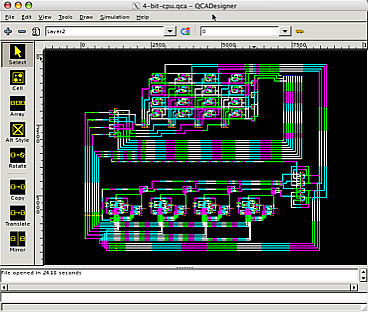
My work addressed those questions. I designed and analysed electrode-based clocking for molecular QCA, built new simulation engines within the QCADesigner tool, characterised how crosstalk, cell displacement and clock phase errors cause faults, and extended automatic test pattern generation to the majority and minority logic these technologies use. My doctoral work developed efficient methods for simulating the correlated quantum dynamics of large QCA circuits.
Publications
Six journal papers, ten conference papers and two theses. Where I have a copy, the paper is linked as a PDF.
Journal papers
- 2014
Efficient Simulation of Correlated Dynamics in Quantum-Dot Cellular Automata (QCA)
IEEE Transactions on Nanotechnology, vol. 13, no. 2, pp. 294–307
- 2014
Calculating the Steady-State Polarizations of Quantum Cellular Automata (QCA) Circuits
Journal of Computational Electronics, vol. 13, no. 3, pp. 569–584, September 2014
- 2013
Consequences of Many-Cell Correlations in Clocked Quantum-Dot Cellular Automata
IEEE Transactions on Nanotechnology, vol. 14, no. 4, pp. 638–647
- 2010
Analysis of Field-Driven Clocking for Molecular Quantum-Dot Cellular Automata
Journal of Computational Electronics, vol. 9, no. 1, pp. 16–30
- 2009
Architecture for an External Input into a Molecular QCA Circuit
Journal of Computational Electronics, vol. 8, no. 1, pp. 35–42, March 2009
- 2009
Modeling and Evaluating Errors due to Random Clock Shifts in Quantum-Dot Cellular Automata Circuits
Journal of Electronic Testing: Theory and Applications, vol. 25, no. 1, pp. 55–66, February 2009
Conference papers
- 2012
Engineering Teaching Assistant Training: Increased Engagement Using Varied Delivery Methods
ASEE Annual Conference and Exposition on Engineering Education, June 2012
- 2011
The UBC Teaching Assistant Training Program
ASEE Annual Conference and Exposition on Engineering Education, June 2011
- 2011
Ground State Simulation Tool for Field-Clocked Three-State Molecular Quantum-dot Cellular Automata (QCA)
Invited paper, IEEE International Symposium on Circuits and Systems (ISCAS), May 2011
- 2008
The Characterization of the Displacement Tolerance of QCA Circuits
Nano Devices, Circuits and Systems 2008, Cambridge, Massachusetts, pp. 49–53, September 2008
- 2008
Quantum Mechanical Simulation of QCA with a Reduced Hamiltonian
IEEE Nano 2008, Arlington, Texas, pp. 327–330, August 2008
- 2008
Testing of Combinational Majority and Minority Logic Networks
International Mixed-Signals, Sensors and Systems Test Workshop 2008, Vancouver, Canada, pp. 1–6, June 2008
- 2007
On the Error Effects of Random Clock Shifts in Quantum Cellular Automata Circuits
22nd IEEE International Symposium on Defect and Fault Tolerance in VLSI Systems (DFT 2007), Rome, Italy, pp. 487–495
- 2007
A Cross Layer Optimization Mechanism to Improve H.264 Video Transmission over WLANs
IEEE Consumer Communications and Networking Conference, pp. 875–879, January 2007
- 2006
Crosstalk in QCA Arithmetic Circuits
Proceedings of SPIE, vol. 6313, San Diego, California, pp. 631306.1–631306.9
- 2005
Design and Evaluations of a Fiber Based CDMA Wireless Link
International Conference for Upcoming Engineers (ICUE), Windsor, Ontario
Theses
- 2014
Investigation of the Correlated Dynamics of Quantum-Dot Cellular Automata Circuits and Systems
Ph.D. dissertation, The University of British Columbia, May 2014
- 2007
Clocking Electrode Design and Phase Analysis for Molecular Quantum-Dot Cellular Automata Based Circuits
M.A.Sc. thesis, The University of British Columbia, May 2007
Teaching
Alongside the research, I taught ten course offerings as a sessional instructor, trained new teaching assistants for the Faculty of Applied Science, and supervised five undergraduate research projects on QCA.